South Street Seaport history, pier by pier
In short
The South Street Seaport was New York’s main port until the Civil War. Its streets stand on landfill laid down from 1798, Schermerhorn Row was finished in 1812, and the Fulton Fish Market traded here from 1822 to 2005. A 1985 festival mall on Pier 17 came after the museum’s rescue of the old blocks; after Hurricane Sandy it was rebuilt and reopened in 2018.
- 1812Schermerhorn Row
- 1822Fish market opens
- 1883Brooklyn Bridge
- 1967Museum founded
- 1985Pier 17 mall
- 2005Market leaves
- 2012Sandy
- 2018New Pier 17
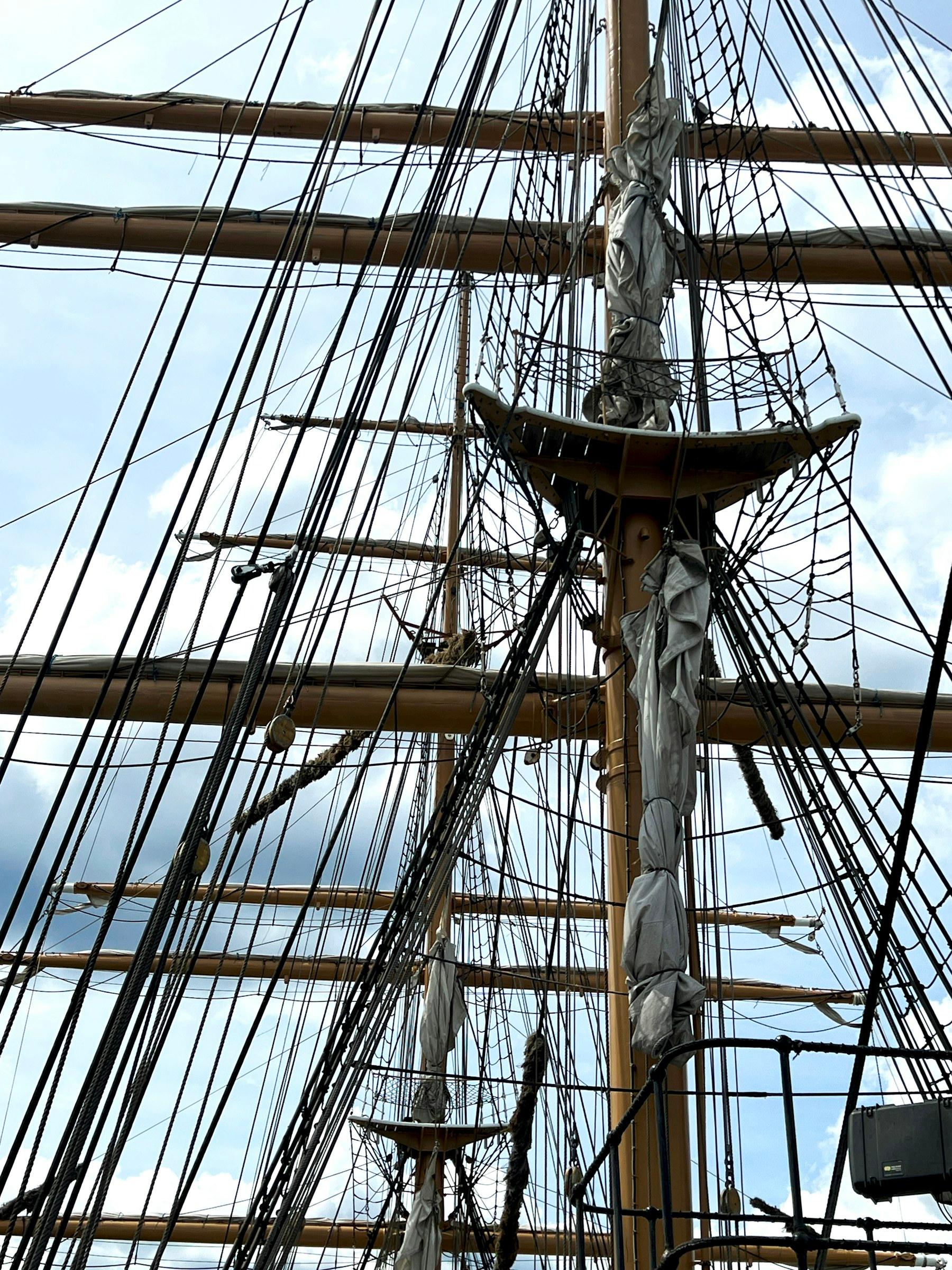
Photo: Lance Grandahl / Unsplash · The rigging of a tall sailing ship (not a Seaport Museum vessel)
How was the South Street Seaport built?
Largely on landfill. The Dutch founded New Amsterdam in 1624, and the East River shore was soon the place to load ships. Between 1798 and about 1810 the city pushed the waterfront three blocks out into the river, laying down the land that South Street, its piers and its slips stand on today.
Merchants built out from the new bulkhead in timber piers and left water between them as slips, where ships tied up bow-on to the street. Beekman Slip became the Manhattan end of the Fulton Ferry to Brooklyn in 1813, which is how Fulton Street and the market that took its name came to anchor the district. Several streets, like Peck Slip and Coenties Slip, still carry the names.
What is Schermerhorn Row?
A row of brick warehouses and counting houses on Fulton Street, built for the merchant Peter Schermerhorn and completed in 1812, after a land grant in 1807. It is among the oldest surviving commercial buildings in Manhattan. Saving it from neglect and redevelopment was the first mission of the South Street Seaport Museum in 1967.
The row was designated a New York City landmark in 1968, ahead of the historic district around it. Its upper floors once held the offices where merchants kept accounts and booked cargo; its ground floors opened on to the street and the slips beyond. The museum moved into four levels of its historic buildings in 1997.
When was the Seaport New York's busiest port?
From the 1810s to the Civil War. South Street merchants pioneered scheduled transatlantic sailings in 1818, the Erie Canal opened in 1825, and by 1860 more than 4,000 vessels a year arrived from foreign ports. By 1870, steamships carried nine in ten ocean passengers, and the deep-water trade moved to the Hudson.
The museum dates the port’s peak to around 1850. Fire was the other force in the story: the Great Fire of December 17, 1835 destroyed many of the district’s buildings, which is why so much of what stands today dates from the decades just after. When the Brooklyn Bridge opened above the piers on May 24, 1883, the old sailing-ship waterfront was already in decline.
What was the Fulton Fish Market?
New York's wholesale fish market, which traded on Fulton and South Streets from 1822 to 2005. Fish merchants moved into a building on the river between today's Piers 17 and 18 by 1831; a fire destroyed much of it in November 1878; the Tin Building went up in 1907 and a new market building in 1939.
In 2005 the market moved to Hunts Point in the South Bronx, into a refrigerated building that met modern food-safety rules. The Tin Building, damaged by fire in 1995 and empty after the move, was taken apart, raised above the flood line and rebuilt about 30 feet from its old spot. Its story continues on the Tin Building page.
What is the South Street Seaport Museum?
A maritime museum founded in 1967 by preservationists, among them Peter and Norma Stanford, to save Schermerhorn Row and the old waterfront. It is at 12 Fulton Street and keeps a fleet of historic ships, including the 1885 tall ship Wavertree. Its rescue of the district led to the historic district designation of 1977.
South Street Seaport Museum
Maritime museum · 12 Fulton Street
- Founded 1967; formally chartered April 28, 1967
- Ships include Wavertree (1885), lightship Ambrose, schooner Pioneer (1885) and tug W.O. Decker (1930)
- Listed hours Nov 26, 2026: Wed–Thu preregistered slots 1–5pm; Fri–Sun 11am–5pm
- Pioneer and W.O. Decker sailing season ended for 2026; returns 2027
What was the Pier 17 mall?
The Pier 17 Pavilion, a glass festival marketplace of shops and food stalls designed by Benjamin Thompson & Associates for the Rouse Company. It opened on September 11, 1985, two years after Rouse's Fulton Market Building, as part of a plan to bring visitors back to the waterfront. It stood for 28 years.
Ownership passed from Rouse to General Growth Properties in November 2004, and in 2010 to the company that became the Howard Hughes Corporation. By then the mall was showing its age; its last night came on September 9, 2013.
How did Hurricane Sandy change Pier 17?
Sandy flooded the Seaport in late October 2012. The Pier 17 Pavilion itself was spared the worst, but its shops stayed shut for more than a month and many never reopened. The city approved a redevelopment in February 2013, the mall closed that September, and demolition ran through 2014.
SHoP Architects designed the replacement: a four-storey glass building whose roof was given over to public space and performance. A 50-storey tower proposed alongside it in 2013 was cut back and then dropped in December 2015 after community opposition. The new Pier 17 opened in July 2018, at a reported cost of $425 million, with an ESPN studio that had opened inside it that April.
Who owns the South Street Seaport today?
Seaport Entertainment Group owns and manages Pier 17, the Fulton Market Building and the Tin Building. It was spun off from Howard Hughes Holdings in the summer of 2024. The museum, its ships and the historic streets remain the district's public heart, and the city's landmark rules still govern the old blocks.
In 2026 the Tin Building’s food hall gave way to the Balloon Museum, and Meow Wolf has signed a 20-year lease for about 75,000 square feet at Pier 17, announced in March 2025. The waterfront keeps changing; the street plan of 1810 does not.
South Street Seaport timeline
Twenty dates that explain the waterfront, from New Amsterdam to the Balloon Museum. Each one comes from the South Street Seaport Museum’s history, the historic district record, or the press reports listed in the sources at the end of this page.
| Year | What happened |
|---|---|
| 1624 | The Dutch West India Company establishes New Amsterdam at Manhattan's southern tip. |
| 1798–c.1810 | South Street is built on landfill, three blocks out into the East River from the old shore. |
| 1812 | Schermerhorn Row's warehouses and counting houses are completed. |
| 1818 | South Street merchants pioneer scheduled transatlantic sailings (the Black Ball Line). |
| 1822 | The Fulton Fish Market opens on Fulton and South Streets. |
| 1835 | The Great Fire of December 17 destroys much of the old city, including Seaport buildings. |
| 1860 | More than 4,000 vessels arrive from foreign ports; South Street is the city's main seaport. |
| 1883 | The Brooklyn Bridge opens on May 24, above the Seaport's piers. |
| 1907 | The Tin Building is built for the fish market. |
| 1967 | The South Street Seaport Museum is founded to save Schermerhorn Row. |
| 1977 | The original South Street Seaport Historic District is designated on May 11. |
| 1983 | The Rouse Company's Fulton Market Building opens on July 28. |
| 1985 | The Pier 17 Pavilion mall opens on September 11. |
| 2005 | The Fulton Fish Market moves to Hunts Point in the Bronx. |
| 2012 | Hurricane Sandy floods the Seaport in late October. |
| 2013 | The Pier 17 Pavilion closes for good on September 9. |
| 2018 | Today's Pier 17, by SHoP Architects, opens in July. |
| 2022 | The rebuilt Tin Building opens as a Jean-Georges food hall. |
| 2024 | Seaport Entertainment Group is spun off from Howard Hughes. |
| 2026 | The Tin Building food hall closes; the Balloon Museum moves in. |
Frequently asked questions
What is South Street Seaport known for?
It was New York's main seaport until the Civil War, home of the Fulton Fish Market from 1822 to 2005, and one of the city's oldest surviving commercial districts, with the 1812 Schermerhorn Row at its heart. Today it is known for Pier 17, its Rooftop concerts, the museum ships and its cobbled streets.
What is the oldest neighborhood in Manhattan?
Manhattan's southern tip, where the Dutch West India Company established New Amsterdam in 1624, is the oldest settled part of the island. The Seaport grew along that settlement's East River shore; South Street itself sits on landfill added between 1798 and about 1810, three blocks out from the original waterfront.
What ships are docked at South Street Seaport?
The South Street Seaport Museum keeps a fleet of historic vessels, including the 1885 tall ship Wavertree, the lightship Ambrose, the 1885 schooner Pioneer and the 1930 tugboat W.O. Decker. Boarding and sailing are seasonal: the museum said its 2026 sailing season had ended, with sails returning in 2027.
When did the Fulton Fish Market leave the Seaport?
In 2005. After 183 years on Fulton and South Streets, the wholesale market moved north to Hunts Point in the South Bronx, into a modern refrigerated building. Its old sheds were left behind; the 1907 Tin Building was later taken apart, raised and rebuilt beside Pier 17, reopening as a food hall in 2022.
What happened to the old Pier 17 mall?
The Pier 17 Pavilion, a glass shopping mall built by the Rouse Company, opened on September 11, 1985. Hurricane Sandy damaged it in October 2012 and many shops never came back. It closed for good on September 9, 2013, was demolished in 2014 and replaced by today's Pier 17, which opened in July 2018.
Sources
- 01History of the SeaportSouth Street Seaport Museum · checked Nov 26, 2026
- 02About Schermerhorn RowSouth Street Seaport Museum · checked Nov 26, 2026
- 03Visit: hours, ships and exhibitionsSouth Street Seaport Museum · checked Nov 26, 2026
- 04Pier 17 and South Street Seaport: history and timelineWikipedia · checked Nov 26, 2026
- 05Last night arrives for South Street Seaport mallCBS New York · published Sep 9, 2013
- 06South Street Seaport's Pier 17 reborn after Superstorm Sandy devastationABC7 New York · published 2018
- 07Pier 17 at South Street Seaport by SHoP ArchitectsArchitectural Record · published 2018
- 08Seaport Entertainment Group completes separation from Howard Hughes HoldingsBusiness Wire (company release) · published Aug 1, 2024
- 09The Tin Building is closing to become a Balloon MuseumTribeca Citizen · published Feb 23, 2026
History updated . Every source on the site is listed on the Sources page.